
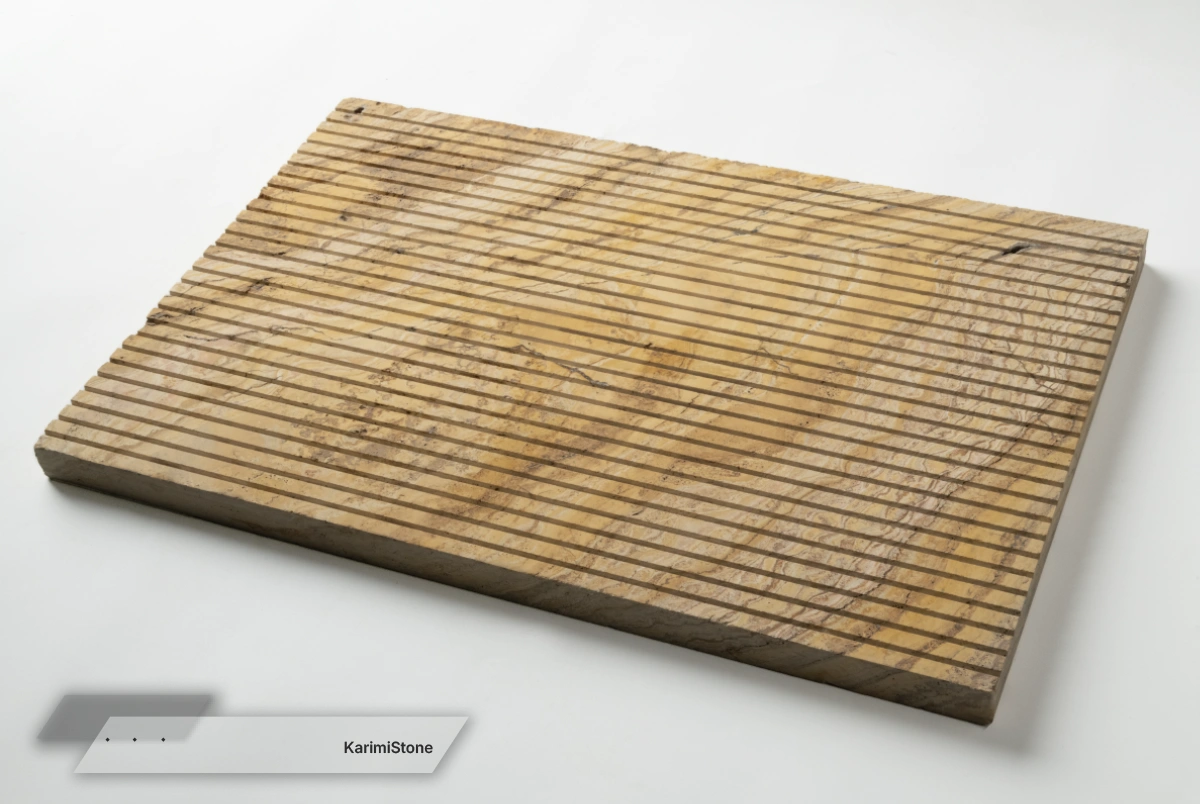
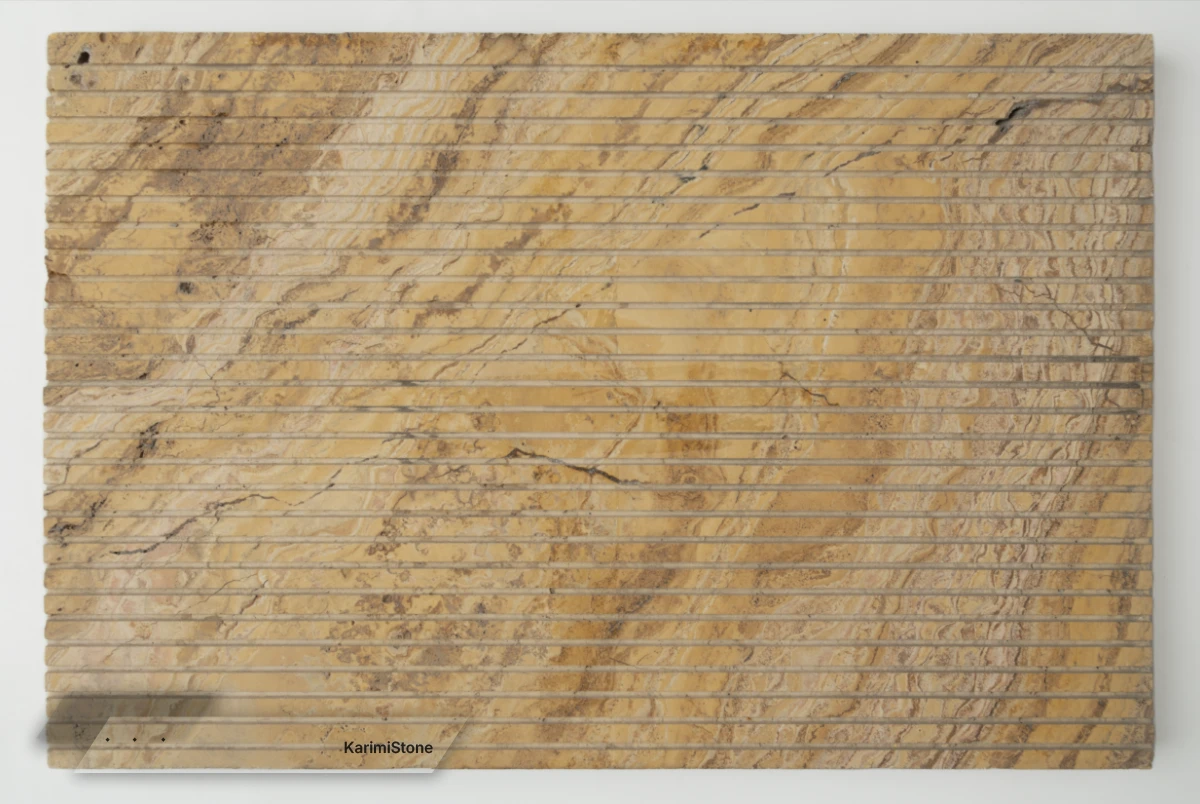
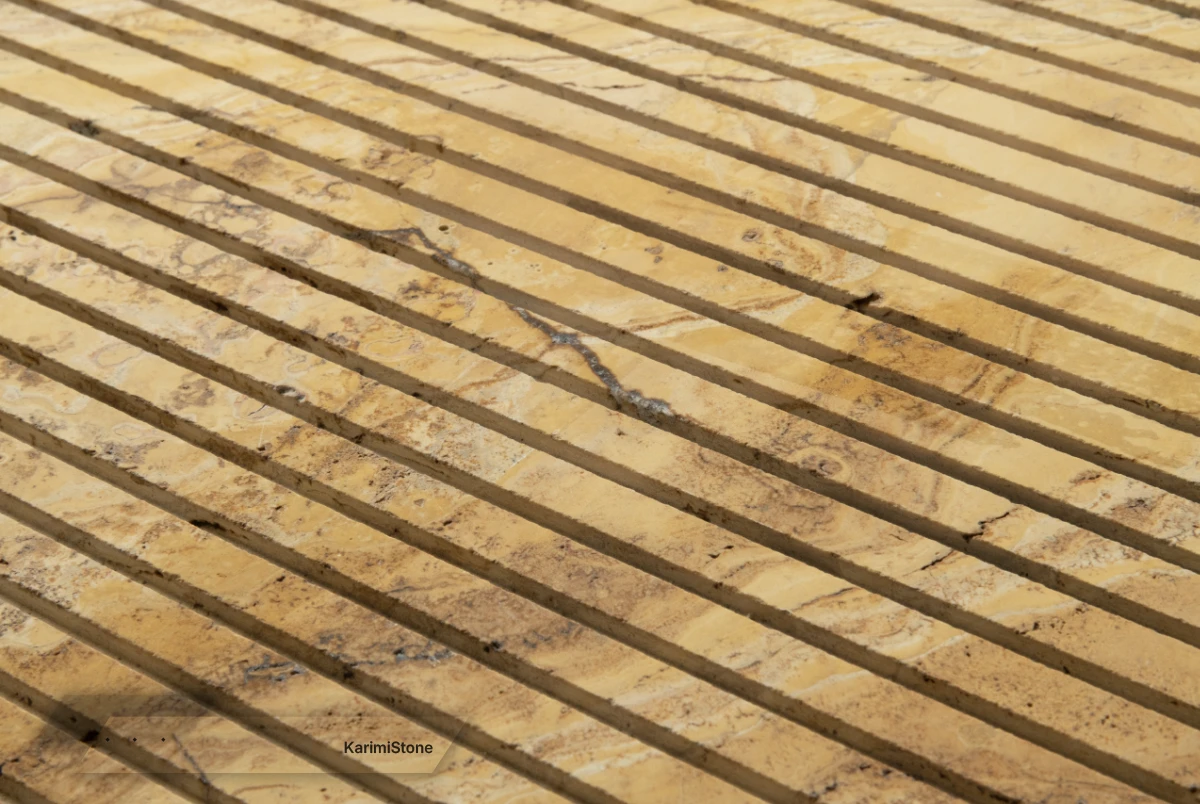
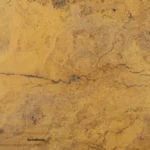
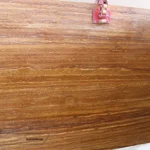







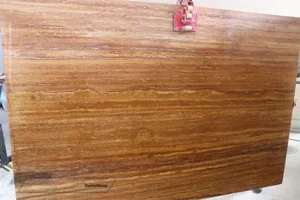
Yellow Travertine Grooved

P2
Slip Rating
V2
Colour Variation
Quality Grade:
SAFDS-34-RWTFE

Technical Specifications

Porosity
15%
ASTM C97
Density
2333kg/m³
ASTM C97
Water Absorption
2.33%
ASTM C97
Compressive Strength
52MPa
ASTM C170
Abrasion Resistance
8.5mm
EN 14157
Cold Resistance
-10°C
Standard
Heat Resistance
200°C
Standard
Flexural Strength
9.2MPa
Standard

Project Configuration

Installation & Care

Adhesive

Avoid abrasive brushes

Mild soap solution

About This Material

Yellow Travertine Grooved

Technical & Product Overview

Yellow travertine grooved is a functional and architectural stone solution designed for projects that require surface grip, texture control, and visual definition. Based on yellow travertine extracted from well-known Iranian quarries, this finish is widely used in areas where safety, durability, and design clarity are equally important. For more natural stone products and finishes, visit the
Karimi Stone product collection.

Yellow travertine itself is valued for its warm color, layered structure, and good technical behavior. When combined with a grooved surface, the stone moves beyond pure beauty and becomes a performance-oriented material suitable for both interior and exterior architectural applications.


Understanding Yellow Travertine as a Base Material

Yellow travertine is a sedimentary natural stone formed by mineral deposits over long periods. Its structure includes natural pores and layers, which help reduce weight and improve bonding with mortar and installation systems. The technical performance of natural stones is typically evaluated according to international standards such as
ASTM natural stone testing standards.

Key characteristics of yellow travertine include:

  • Only selected yellow travertine blocks are used for production
  • The honed finish is applied carefully to achieve a smooth and consistent surface
  • Different formats are available, including slab, tile, free length, steps, and risers
  • Each piece is checked for correct thickness, surface feel, and color balance
  • The stone is prepared with export-safe packing and dependable shipping arrangements

These properties make yellow travertine a reliable base material for specialized surface treatments such as grooved finishes.


Visual Character of yellow travertine grooved

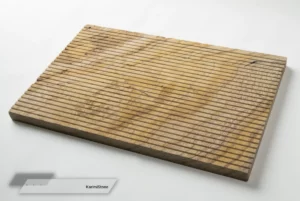
The visual character of yellow travertine grooved is defined by rhythm, texture, and controlled shadow lines. The grooves create linear patterns on the surface, adding depth and architectural interest without overwhelming the natural color of the stone.

Color tones typically range from lemon yellow to golden and cream-yellow shades, depending on the quarry and grade. The grooved lines emphasize these tones by creating contrast between light and shadow, especially in outdoor or naturally lit environments.

This finish is often selected for projects where designers want:

  • A structured and directional surface
  • Visual movement without strong veining
  • A balance between decoration and function


Grooved Finish Explained

Grooved is a surface treatment created by cutting parallel channels or lines into the stone surface using mechanical tools. These grooves can vary in width, depth, and spacing depending on design requirements and functional needs.

In yellow travertine grooved, the grooves serve both beauty and technical purposes. Visually, they introduce texture and pattern. Functionally, they improve slip resistance and help manage surface water, especially in outdoor and semi-open areas.

Key characteristics of grooved:

  • Linear textured surface
  • Improved slip resistance
  • Reduced surface glare
  • Clear architectural definition
  • Suitable for high-traffic and transition areas

Unlike smooth finishes, grooved surfaces are designed to interact with movement, weather, and use conditions.


Architectural Applications of Yellow Travertine Grooved

Because of its performance-oriented surface, yellow travertine grooved is commonly used in areas where safety and durability are critical:

Interior Applications

• Interior wall cladding for residential and commercial spaces
• Stair side walls and vertical surfaces
• Entrance halls and lobby walls

Design & Decorative Uses

• Feature wall cladding with linear grooved patterns
• Facade applications in controlled exterior environments
• Architectural accent walls and vertical design zones

The grooved surface makes yellow travertine especially suitable for wall cladding and facade use, where texture, light control, and visual depth are important.


Technical Performance Notes

From a technical perspective, yellow travertine grooved offers several practical advantages:

  • Increased surface grip compared to smooth finishes
  • Better performance in wet or dusty conditions
  • Reduced visual impact of wear over time
  • Good durability under regular foot traffic

The grooves also help reduce water accumulation on the surface.


Design Compatibility

Yellow travertine grooved works well with various architectural styles including modern, classical, commercial, and landscape-oriented designs.
Yellow Travertine Grooved

The Role of Karimi Stone

Karimi Stone (Negin Sang Karimi) supplies and export yellow travertine grooved for domestic and export projects. More information about available stone solutions can be found on the
Karimi Stone official website.

Karimi Stone provides:

  • Careful selection of yellow travertine blocks
  • Custom grooved patterns based on project requirements
  • Production in slabs, tiles, steps, and cut-to-size formats
  • Strict quality control
  • Export-grade packaging and reliable logistics


Final Summary

Yellow travertine grooved combines the warm color and natural character of yellow travertine with a functional surface design, supporting safety and durability in architectural projects.
Leave a Reply

Your email address will not be published. Required fields are marked *

How would you rate this?
- Select a rating

Reference Catalog

Stone Size Guide

Standard slab, tile, pattern and step sizes to help plan your takeoffs and orders. Dimensions are shown in centimeters unless otherwise stated.

Standard offering ! Tolerance indicated as ±

Slabs

Standard slab supply for project-scale cutting and fabrication.

Standard Slab

Dimensions (cm)
  • (250 × 150) ±20
  • (250 × 150) ±20
Thickness
  • 2 cm
  • 3 cm

Big Slab

Dimensions (cm)
  • (270 × 170) ±20
  • (270 × 170) ±20
Thickness
  • 2 cm
  • 3 cm
Tolerance applies to length and width. Thickness tolerance is available upon request.

Ask Price

Name(Required)
Product Details
SKU Code
SAFDS-34-RWTFE
Internal reference
Product Title
Yellow Travertine Grooved
Public name

Slip Rating & Wet Pendulum Guide

A concise overview of P1–P5 slip ratings so you can align each Karimi Stone finish with the right space, moisture level and safety expectation.

OVERVIEW

P1 → P5 safety band
P1 P2 P3 P4 P5
What the Wet Pendulum Test (WPT) tells you
The WPT measures how slippery a surface becomes when wet. Each finish is given a P rating from P1 (higher slip risk) through to P5 (maximum grip). As the number increases, the expected slip resistance also increases.

RATING SCALE SNAPSHOT

From higher slip risk to maximum grip
Each Karimi Stone P icon below is your quick visual code before checking detailed applications.

P1 → P5  Left = smoother | Right = more textured

P1

Dry circulation

Higher slip risk

For dry-only walkways and light traffic areas where water is not expected on the surface.

P2

Light splash

Occasional moisture
Bathrooms, small kitchens and transition areas that see brief, easily managed water.
P3

Everyday wet public

Balanced grip
Entries, amenities, undercover car parks and fresh food retail where wet floors are common.
P4

High exposure

Wet, high traffic
Pool surrounds, communal showers and external ramps under 1:14 where water is constant.
P5

Maximum grip

Highest safety band

Commercial kitchens, covered loading docks and pool ramps or stairs leading into water.

HOW TO READ THIS POPUP

Start with water, movement and consequence
Consider how wet the floor can get, how quickly people move, and how critical a slip could be. Then use the cards below to align each area of your project with a suitable P rating before you select a Karimi Stone finish.

TYPICAL APPLICATIONS

P1 – dry circulation
Higher slip risk when wet

P1
For areas intended to remain dry with controlled walking speeds – such as supermarket aisles, separate shops inside centres or dry lobby and corridor zones.
Retail aisles
Dry-only entries
Light traffic

P2 – light splash
Transitional & semi-wet areas

P2
For spaces where occasional water is expected but quickly managed – like hotel bathrooms, apartment kitchens, laundries and transition zones between wet and dry areas.
Hotel bathrooms
Apartment kitchens
Laundries

P3 – regularly wet public
Balanced everyday grip

P3
Used where wet conditions are common – entries and access ways, toilet facilities in public buildings, undercover car parks and fresh food retail areas.
Public entries
Toilet facilities
Undercover parking

P4 – high exposure
Wet, high traffic environments

P4
Selected for consistently wet and busy areas such as pool surrounds, communal showers, external ramps under 1:14 and service zones behind bars.
Pool surrounds
Communal showers
Light traffic

P5 – maximum grip
Demanding commercial use

P5
For the most demanding applications: commercial kitchens, loading docks under cover, steep external ramps, swimming pool ramps and stairs leading into water.
Commercial kitchens
Loading docks
Pool ramps & stairs
TEST STATUS CODES

Where a P rating is not shown

For the most demanding applications: commercial kitchens, loading docks under cover, steep external ramps, swimming pool ramps and stairs leading into water.

?

N/T

No Wet Pendulum slip testing has yet been performed on this surface finish.

N/A

Wet Pendulum testing is not applicable or cannot be performed for this surface format.

W

WPT

Indicates that the Wet Pendulum Test method has been used to determine the rating.

Always refer to the specific data sheet for each Karimi Stone product to see which of these codes or P ratings apply.

Information disclaimer

This guide is a general summary only and does not constitute legal or compliance advice. Slip resistance requirements vary by project, location and use. Always confirm ratings and regulatory obligations with qualified slip-rating and building-compliance professionals before final specification.

Request Quote

This field is for validation purposes and should be left unchanged.
Name(Required)