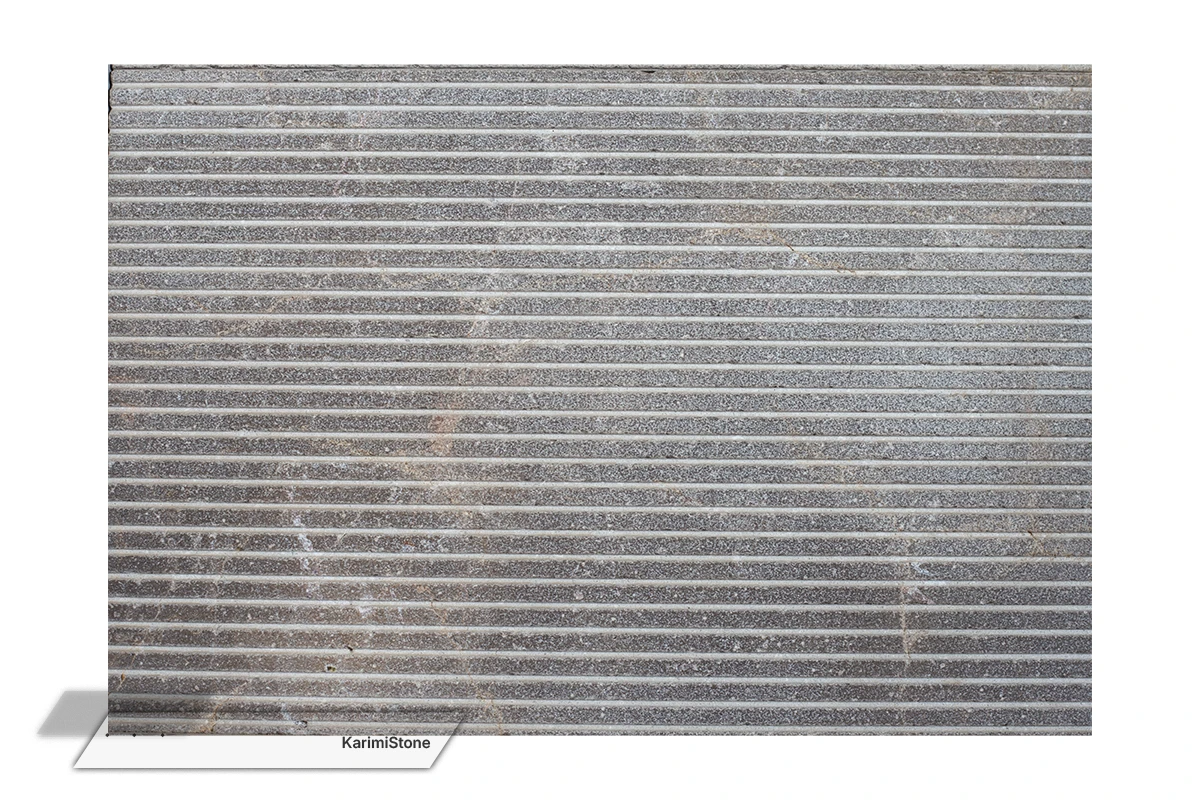
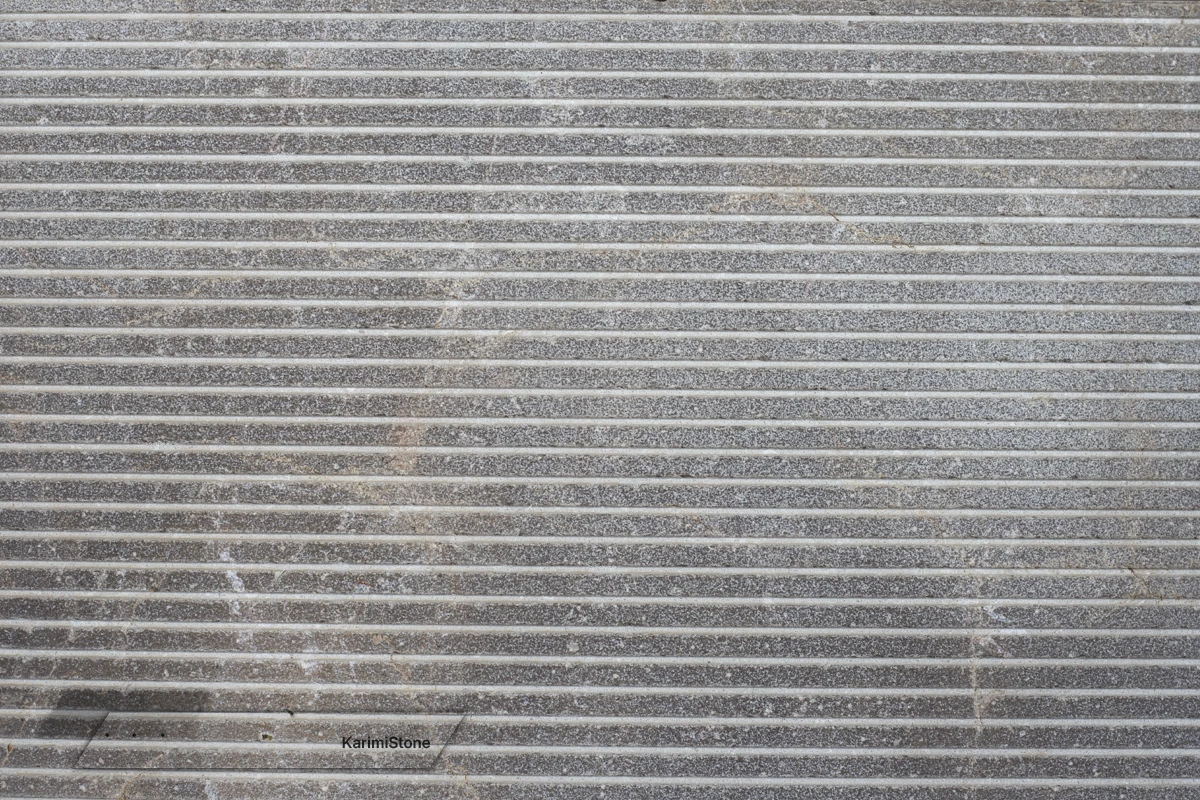
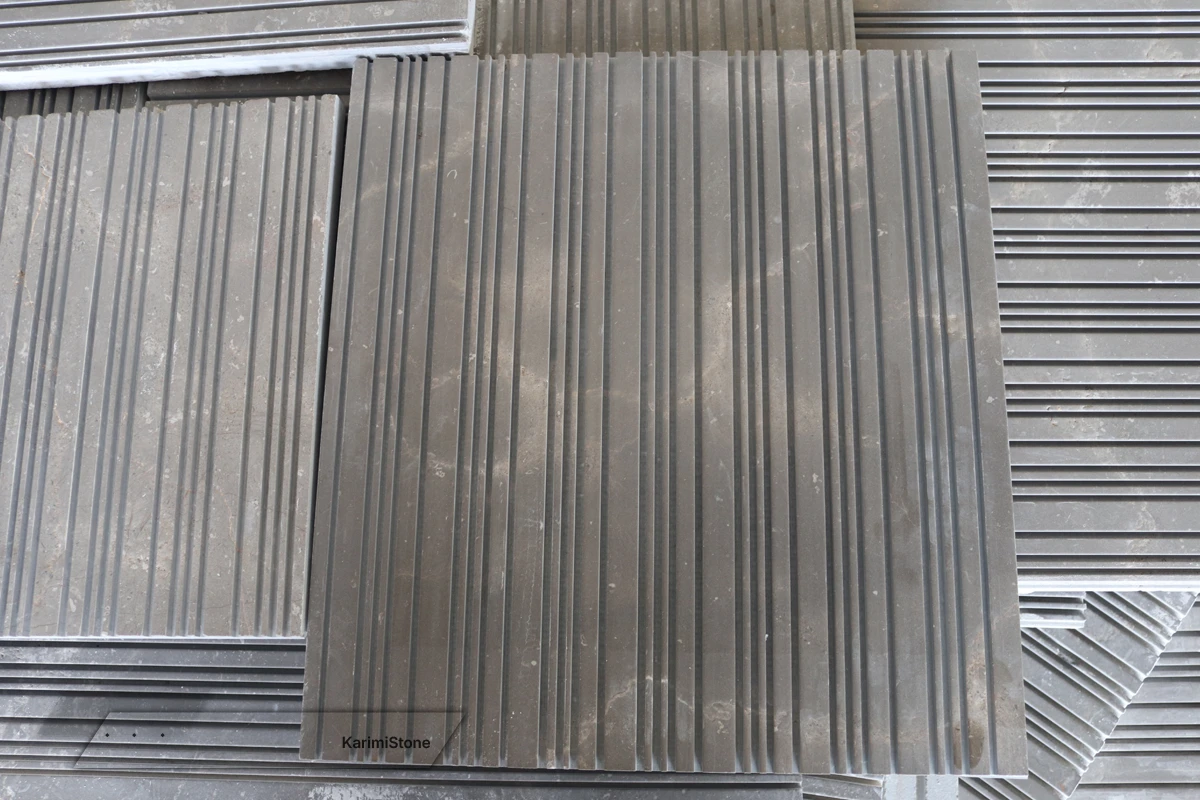
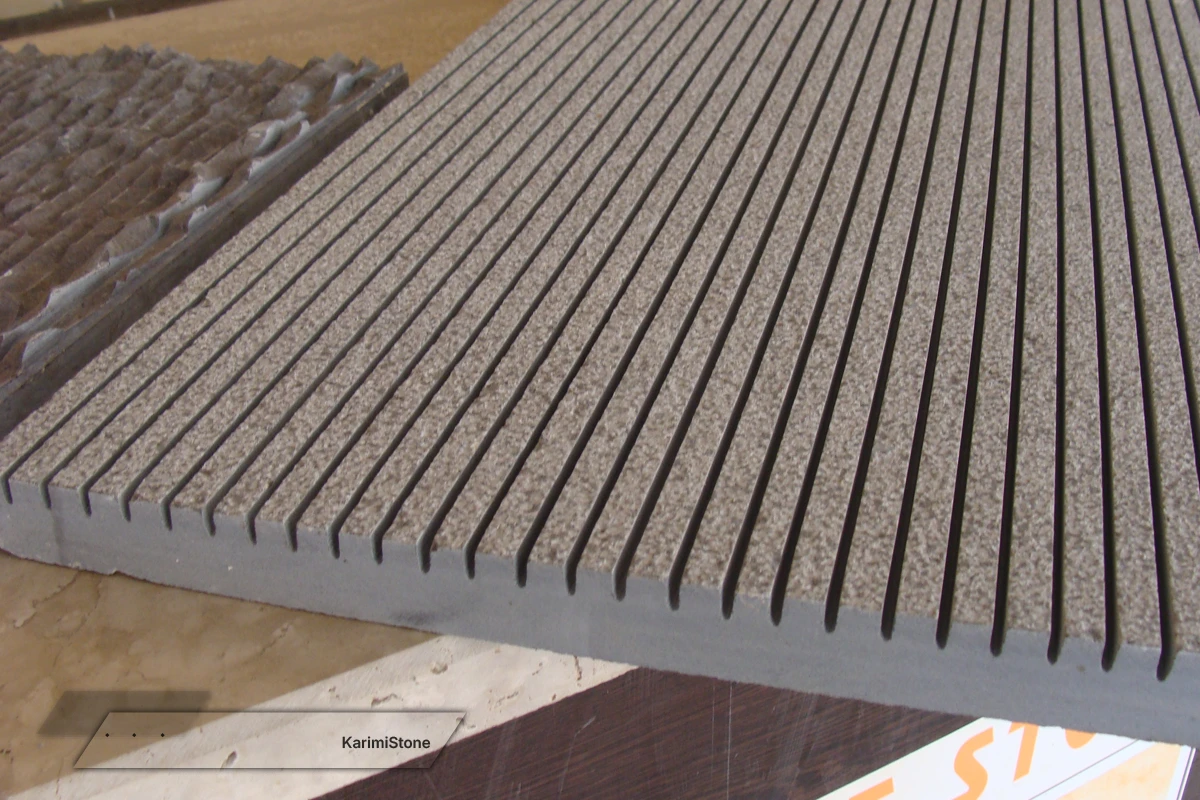
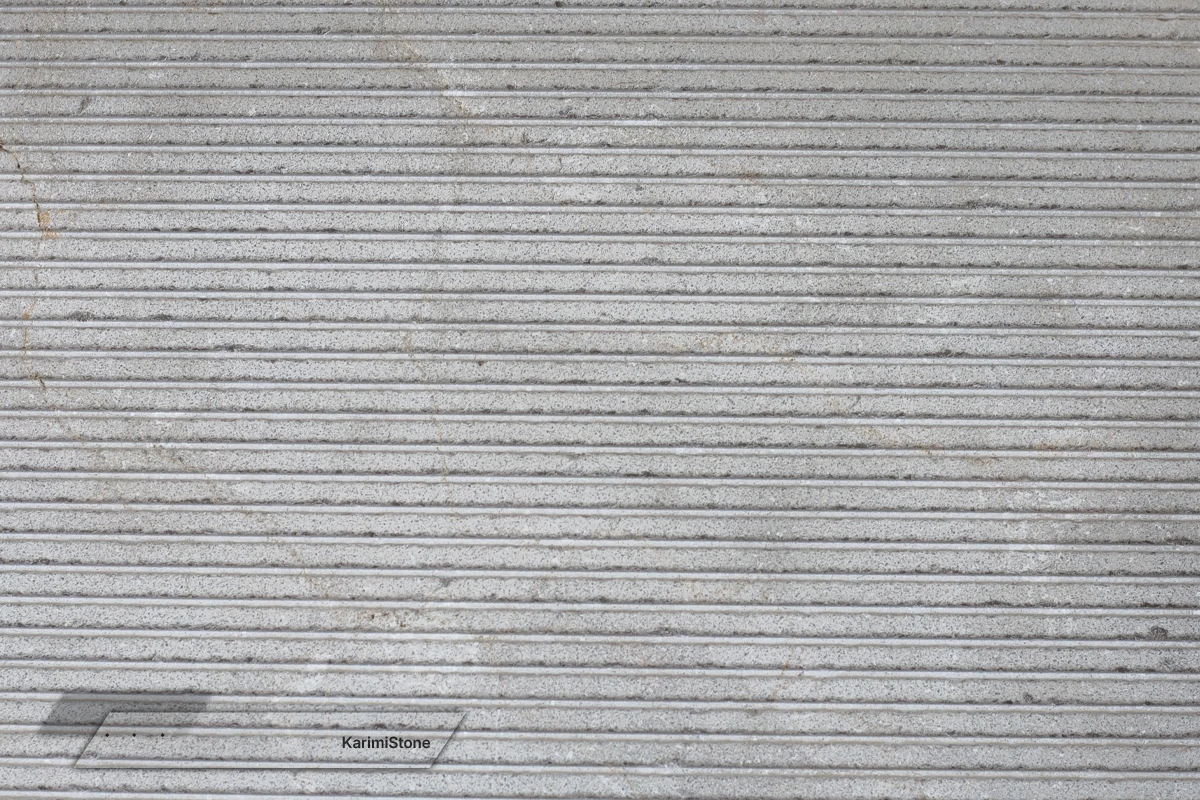

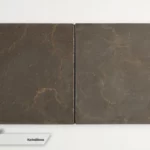

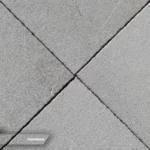
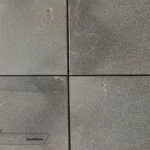
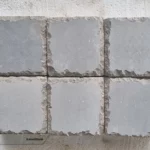
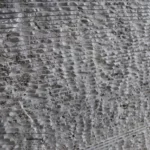
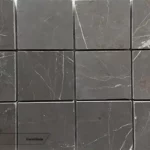
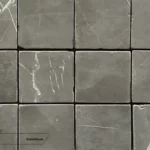











Grey Marble Grooved is an Iranian natural stone with a calm grey color, dense marble structure, minimal visual movement, and precisely cut parallel grooves. The Grooved finish creates a structured linear surface while maintaining the stone’s natural grey appearance and low-reflection architectural character.
The grooves are mechanically cut into the stone surface after initial cutting and preparation. Their width, depth, and spacing can be adjusted according to the architectural design and functional requirements of the project.
With its neutral color and organized linear texture, Grey Marble Grooved can be considered for exterior and interior walls, circulation areas, garden paths, landscape architecture, selected flooring, entrances, stairs, ramps, and other projects where a controlled geometric surface is required.
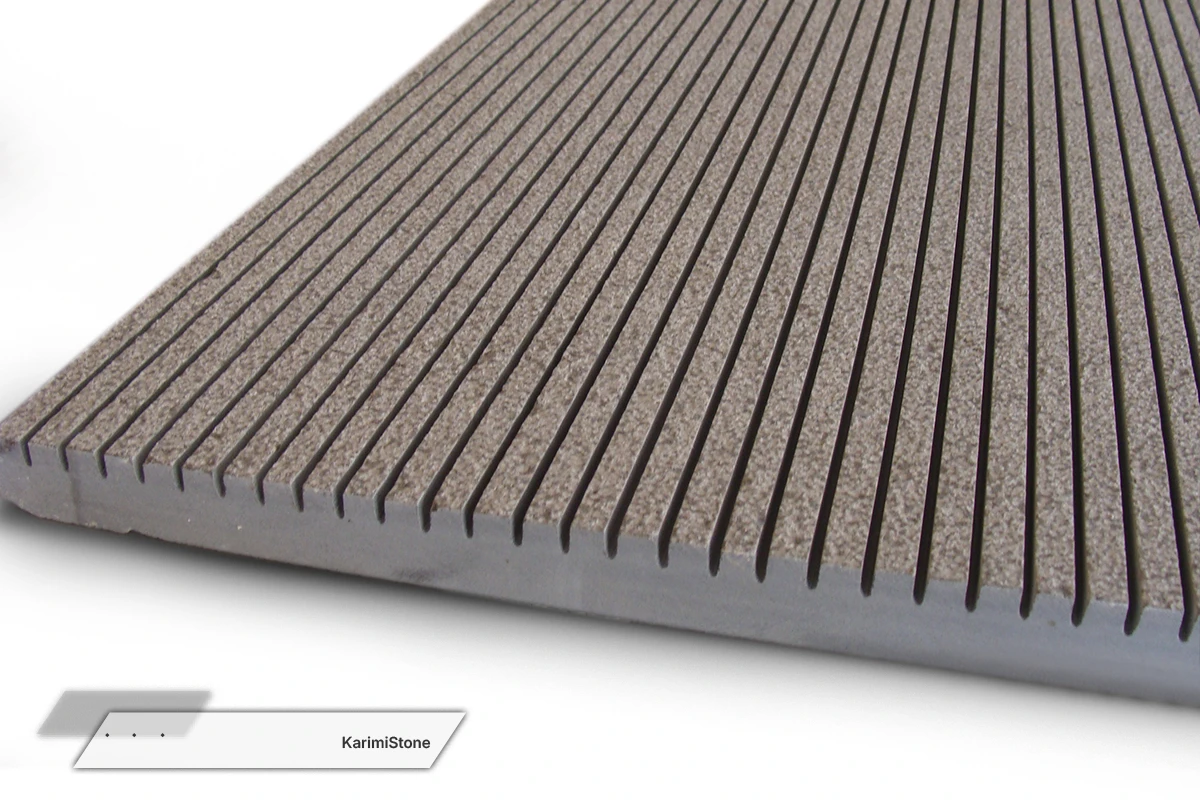
What Is Grey Marble Grooved?
Grey Marble Grooved is natural Iranian Grey Marble processed with parallel mechanical channels across the stone surface.
The grooves create a regular linear pattern rather than an irregular rough texture.
This gives the finished stone two distinct characteristics: a functional textured surface and a clean architectural rhythm.
The natural grey background remains visible between the grooves, allowing the material to maintain a restrained and neutral appearance.
What Is Grey Marble?
Grey Marble is a metamorphic natural stone with a compact crystalline structure.
The U.S. Geological Survey (USGS) explains that metamorphic rocks form when pre-existing rocks are transformed by heat, pressure, mineral-rich fluids, or combinations of these conditions; marble is one of the common metamorphic rock types.
The Grey Marble used for this product has a relatively calm visual character and is classified as a Plain pattern in the current Karimi Stone product data.
Typical visual characteristics include:
- Neutral grey background
- Natural variation between lighter and darker grey
- Minimal strong veining
- Compact stone structure
- Clean architectural appearance
- Good visual consistency across large areas
Plain Pattern and Visual Character
This product does not rely on dramatic natural veins for its visual identity.
Instead, its appearance is based on two elements:
- The calm grey background of the natural marble
- The precise parallel lines created by the Grooved finish
This makes the material particularly suitable for contemporary and minimal architecture where repetition, geometry, alignment, and material consistency are important.
What Is a Grooved Finish?
A Grooved finish is created by cutting controlled linear channels into the stone surface using mechanical cutting tools.
The grooves are normally parallel and can be customized according to project requirements.
Important variables include:
- Groove width
- Groove depth
- Distance between grooves
- Number of grooves
- Orientation of the lines
- Stone thickness
- Edge distance
Because these parameters can be controlled during fabrication, the finish can be adapted to different architectural concepts.
Other surface treatments can be compared in Karimi Stone’s Natural Stone Surface Finishes guide.
How Are the Grooves Produced?
The stone is first cut and calibrated to the required dimensions and thickness.
Parallel channels are then created using cutting blades or other precision stone-processing equipment.
For project production, the machining process should control:
- Line spacing
- Groove depth
- Groove width
- Parallel alignment
- Starting and ending positions
- Consistency between individual pieces
Small differences in spacing or depth can become noticeable when multiple pieces are installed side by side, so production consistency is particularly important on large walls and repeated architectural modules.
Architectural Rhythm and Direction
The linear channels provide a stronger sense of direction than a plain smooth surface.
The orientation of the grooves can therefore become part of the architectural design.
Vertical grooves can visually emphasize height.
Horizontal grooves can emphasize width and continuity.
Repeated lines can also help visually organize long corridors, walls, entrances, facades, and landscape elements.
Grooved vs. Bush-Hammered Grey Marble
Both finishes introduce texture, but the visual results are very different.
Grooved Grey Marble has regular, controlled, linear channels.
Bush-Hammered Grey Marble has a more irregular, granular, and point-textured surface.
Grooved stone is therefore generally selected when geometric precision and directional lines are part of the design, while bush hammering is used where a more uniformly rough and granular texture is desired.
Grooved vs. Polished Grey Marble
Polished Grey Marble has a smooth and reflective face.
Grooved Grey Marble introduces physical channels and remains visually more functional and low-reflection.
The two finishes therefore create very different architectural effects even when produced from the same grey stone.
Surface Grip and Wet Areas
Grooves interrupt the smooth plane of the stone and introduce additional surface texture.
This can increase physical grip compared with a completely smooth polished face and is one reason grooved surfaces are often considered for circulation zones, ramps, entrances, and selected wet-area applications.
However, a Grooved finish should not automatically be treated as having a guaranteed slip-resistance class.
Where a project requires a particular slip rating or test result, the exact finished product should be tested according to the applicable standard.
Technical Characteristics
| Property | Current Product Value | Reference |
|---|---|---|
| Porosity | 0.9% | ASTM C97 |
| Density | 2700 kg/m³ | ASTM C97 |
| Water Absorption | 0.15% | ASTM C97 |
| Compressive Strength | 41 MPa | ASTM C170 |
| Abrasion Resistance | 18 mm | EN 14157 |
| Flexural Strength | 20.5 MPa | Product Data |
| Cold Resistance | -30°C | Product Data |
| Heat Resistance | 100°C | Product Data |
These values represent the current Karimi Stone product specification. Natural stone can vary between quarry blocks and production batches, so engineering projects should confirm the properties of the actual material selected for supply.
Applications of Grey Marble Grooved
Exterior Wall Cladding
The linear surface can create a precise architectural character on exterior walls.
Possible applications include:
- Entrance walls
- Exterior feature walls
- Facade details
- Architectural bands
- Columns and vertical elements
For exterior installation, thickness, fixing system, environmental exposure, drainage, and structural requirements should be evaluated for the specific project.
Interior Wall Cladding
Grey Marble Grooved can also be used to create structured interior surfaces.
Possible applications include:
- Lobby walls
- Reception areas
- Commercial interiors
- Hotel walls
- Office entrances
- Feature walls
- Decorative architectural panels
The neutral grey background allows the grooves to become the main design element without creating excessive color variation.
Shared Corridors and Circulation Areas
The original product specification identifies shared corridors and circulation zones as important applications.
The linear texture can visually reinforce the direction of movement while maintaining a durable and ordered architectural appearance.
Landscape and Garden Paths
Grey stone combines naturally with vegetation, concrete, metal, timber, water, and other landscape materials.
Grooved Grey Marble can therefore be considered for selected garden paths, landscape routes, villa areas, and architectural outdoor circulation spaces.
Stairs and Ramps
Grooves can also be designed into steps, stair components, and ramps where additional physical texture or visual direction is required.
The spacing and orientation should be determined according to the architectural and functional requirements of the project.
Bathrooms and Selected Wet Areas
The current Karimi Stone product configuration includes bathroom applications.
For wet areas, the specific groove design, drainage, sealing, cleaning requirements, and tested slip performance should all be considered before specification.
Groove Orientation
The direction of grooves should be chosen deliberately rather than treated as a purely decorative detail.
Depending on the location, grooves may be installed:
- Vertically
- Horizontally
- Parallel to the direction of movement
- Perpendicular to movement
- As repeated architectural modules
The correct orientation depends on the desired visual effect, drainage requirements, cleaning strategy, and functional use of the surface.
Cleaning and Maintenance
Grooved surfaces require a different cleaning approach from completely smooth marble because dust and debris can collect inside the channels.
Routine maintenance can include:
- Regular removal of loose dust
- Controlled vacuuming where appropriate
- Water cleaning when compatible with the installation
- Use of marble-compatible cleaners
- Cleaning along the groove direction
- Periodic inspection of exterior joints and drainage
Strong acidic cleaners should generally be avoided on marble because they can react with carbonate minerals and damage the surface.
Available Formats
The current Grey Marble Grooved product can be supplied in formats including:
- Tiles
- Free-length pieces
- Custom cut-to-size components
- Wall panels
- Architectural strips
- Project-specific grooved elements
Groove width, depth, spacing, stone dimensions, and thickness can be coordinated according to project requirements.
Sorting and Quality Control
For project production, important quality-control criteria include:
- Grey background tone
- Acceptable color variation
- Stone thickness
- Groove width
- Groove depth
- Groove spacing
- Parallel alignment
- Surface cleanliness
- Edge quality
- Consistency between adjoining pieces
For large repetitive installations, an approved reference sample should ideally define both the acceptable stone color and the exact groove geometry before full production begins.
Why Choose Grey Marble Grooved?
- Neutral grey color: Works well with modern, minimal, urban, and commercial architecture.
- Precise linear texture: Creates visual rhythm and geometric order.
- Customizable grooves: Width, depth, and spacing can be adjusted for the project.
- Plain natural pattern: Minimal strong veining keeps large surfaces visually controlled.
- Low-reflection character: Suitable for projects where surface shine is not desired.
- Functional surface texture: Physical grooves can provide more grip than a completely smooth face.
- Architectural versatility: Can be considered for walls, circulation areas, paths, stairs, ramps, and selected wet areas.
- Project manufacturing: Dimensions, thickness, groove geometry, and sorting can be coordinated before production.
Frequently Asked Questions
What is Grey Marble Grooved?
It is Iranian Grey Marble with parallel channels mechanically cut into the surface to create a structured linear texture.
How are the grooves created?
The grooves are mechanically cut into the stone surface using precision cutting equipment after the stone has been prepared to the required dimensions.
Can groove dimensions be customized?
Yes. Groove width, depth, spacing, and orientation can be adjusted according to project requirements.
Is Grey Marble Grooved heavily veined?
No. The current product is classified as Plain and has a relatively calm grey visual character.
What is the difference between Grooved and Bush-Hammered?
Grooved stone has regular linear channels, while Bush-Hammered stone has a more irregular granular texture created by repeated impacts.
Can Grey Marble Grooved be used on walls?
Yes. The current product configuration includes both interior and exterior wall applications.
Can it be used in bathrooms?
Yes, the current product configuration includes bathroom applications, but drainage, installation, cleaning, and required slip performance should be evaluated for the specific project.
Does Grooved automatically mean non-slip?
No. Grooves add physical texture and may increase grip compared with a smooth surface, but any required slip-resistance class should be confirmed through testing.
How should the grooves be cleaned?
Loose debris should be removed regularly, and cleaning should preferably follow the direction of the grooves using products compatible with natural marble.
Grey Marble Grooved by Karimi Stone
Karimi Stone produces, processes, supplies, and exports Iranian natural stone for architectural, residential, commercial, landscape, and urban projects.
For Grey Marble Grooved orders, the stone can be selected according to grey tone, visual consistency, dimensions, thickness, and the required groove width, depth, spacing, and direction.
Production can include stone selection, calibration, precision grooving, project-based sorting, dimensional inspection, quality control, export-grade packaging, and international supply.
With its neutral grey color, Plain natural pattern, precise linear channels, and controlled architectural character, Grey Marble Grooved is a distinctive Iranian natural stone solution for walls, corridors, garden paths, entrances, stairs, ramps, and other structured architectural surfaces.